

Key Takeaways: A Valuer's Core Investment Strategy
What is a valuer's investment strategy
It's a system that prioritises verifiable data, such as land value and homeowner ratios, over market hype to identify investment-grade assets with the lowest possible risk.
Master the Suburb Fundamentals
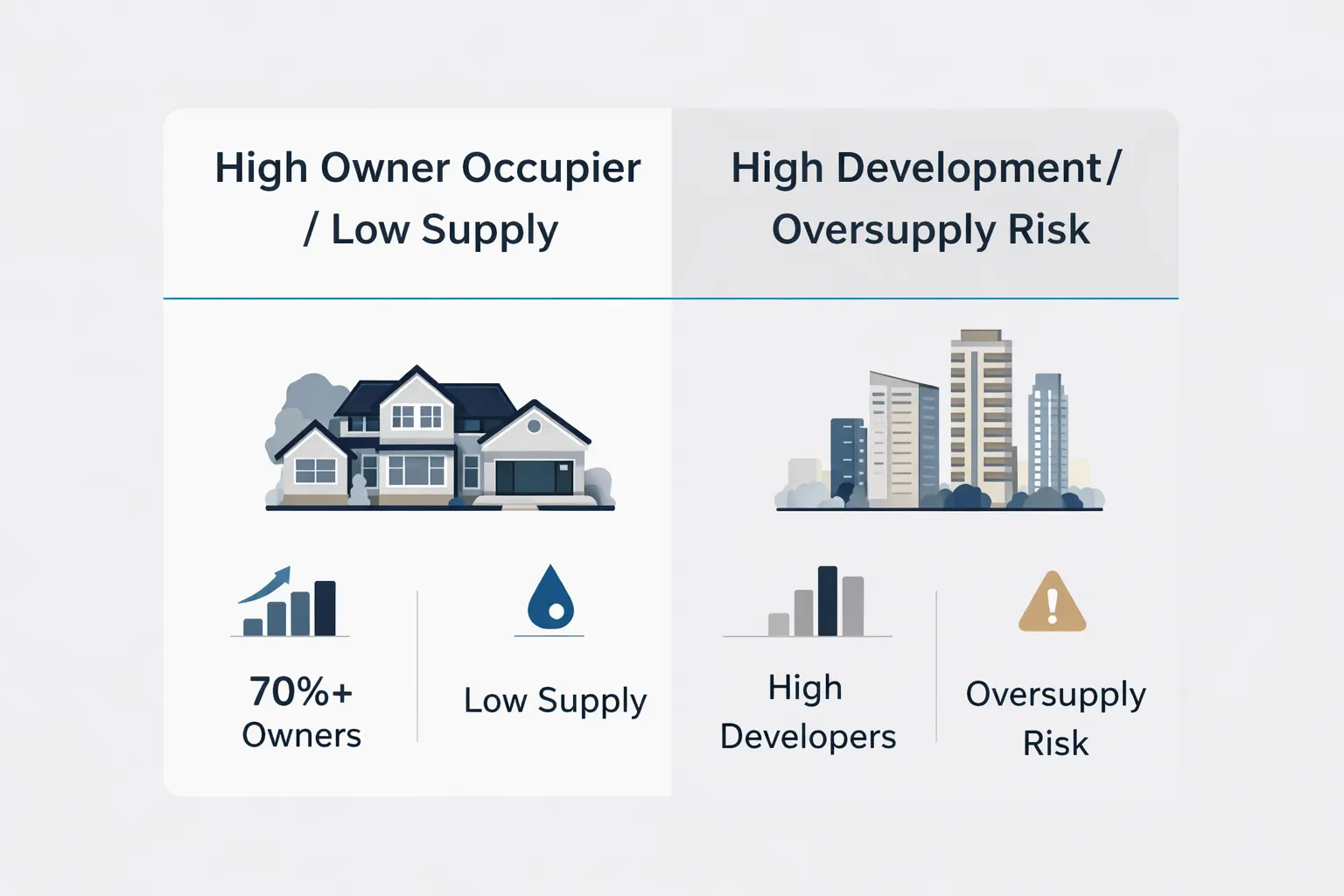
You'll target only the top suburbs with over 70% homeownership and no Residential Growth Zone designation. This proves long-term desirability and protects against oversupply.
Execute Asset-Specific Due Diligence
The two most critical checks for securing value appreciation in Melbourne apartments are calculating a 70% land-to-asset ratio and auditing the last three building Annual General Meetings for red-flag words such as Special Levy.
Negotiate Based on Data, Not Emotion
To avoid the Winner's Curse at auction, you'll establish a maximum price based on your valuation data and have the discipline to walk away if bidding becomes emotional.
Pillar 1: Identifying the Top Investment Suburbs
A great property in a bad location’ll always be a bad investment. Before analysing any specific unit, the investment suburb itself must pass three strict, data-led tests. This is how you’ll identify areas with genuine, long-term potential and find investments that perform. A key part of this is also knowing where not to invest in Melbourne to avoid common pitfalls.
The Metric
High Owner-Occupier Ratio (Over 70%)
The "Why" Behind the Rule
Fear: “Will I be able to find good, long-term tenants?”
The Data: A high ratio proves that the average owner is financially and emotionally invested in the community. This creates price stability and attracts higher-quality tenants, which is essential for a good rental yield.
The Metric
Low Future Housing Supply
The "Why" Behind the Rule
Fear: “What if they build a huge tower next door and my unit’s value drops?”
The Data: You’ll use the free VicPlan tool to ensure there is no nearby Residential Growth Zone. This council designation is a green light for high-rises, and a flood of new units is the fastest way to stall your asset’s appreciation.
Metric
Strong Local Infrastructure
The "Why" Behind the Rule
Fear: “Why would prices go up in this suburb specifically?”
The Data: Value follows jobs and amenities. Look for suburbs with major employment hubs or those directly impacted by government infrastructure projects. This is often how the best new million-dollar suburbs are created, driving sustainable, long-term demand.
Suburb Analysis: From Brunswick to Frankston North and Bayswater
For example, while a suburb like Brunswick has strong appeal due to its amenities, it also has areas zoned for new construction. In contrast, a suburb like Frankston North might present different opportunities based on its specific zoning and homeowner data. You might also consider Broadmeadows for its public transport links. A proper analysis of the median unit price in relation to these factors is critical for anyone buying.
Pillar 2: Due Diligence When Investing in Apartments in Melbourne
Once a suburb passes the test, you’ll investigate the specific property. Most investors make mistakes here by focusing on cosmetic features. The real value and the hidden risks that affect your financial returns are found in these two mechanical checks.
The Land-to-Asset Ratio Calculation
The most critical factor for a unit’s appreciation is land value. Developers can always build more apartments, but they can’t make more land. This is a core principle for successful real estate investment.
- The Mechanic: Your goal is to target only assets in which the land makes up at least 70% of the total purchase price. To calculate this, find a recent sale of a vacant block of land in the same suburb. Divide that land price by the number of units on the block you’re looking at. This gives you a rough land value per unit, which you can compare to the asking price.
- The Audit: This single calculation directly answers the fear: “How do I know this isn’t just another dime-a-dozen apartment?” A high land value indicates your investment is tied to a scarce asset, giving it a strong foundation for future value growth in Melbourne apartments.

The Strata and Building Audit
A low strata fee can hide expensive problems. You must investigate the building’s financial and physical health before buying any investment unit.
- The Mechanic: The selling agent must provide the Section 32 vendor statement. You’ll need to open this legal document and find the minutes from the last three Annual General Meetings. Use the search function to look for these keywords: Special Levy, Cladding, Waterproofing, and Concrete Cancer. The absence of these terms is a very good sign. A property investment advisor coordinates these document reviews alongside independent building and pest inspections to ensure the asset is physically and financially sound. Our framework, for example, includes a meticulous cross-check of the Section 32 against these inspection reports to ensure clients only ever see safe, investment-grade assets.
- The Audit: This directly answers the fear: “What if the building has hidden problems that’ll cost me thousands?” By reading the Annual General Meeting minutes yourself, you’ll spot the red flags that selling agents won’t tell you about, helping protect you from huge, unexpected repair bills.

Need clarity on an asset's true market value?
An independent valuation based on sound data can give you a data-backed price to guide your offer.
Pillar 3: A Data-Led Negotiation Strategy for High Rental Yields
The final step is to secure the unit without overpaying. This is where many buyers let emotion take over, especially in the competitive Melbourne market.
The Winner’s Curse Trap: This is a common phenomenon in which the winner of a bidding war often loses financially because, in the heat of the moment, they paid more than the asset was truly worth.
- The Mechanic: Your only defence against this trap is the data you gathered. Your land value calculation and due diligence findings give you a clear, logical limit on the unit’s value. You’ll treat this as your absolute maximum walk-away price. Our auction bidding service can provide the discipline needed to stick to your strategy.
- The Audit: This answers the fear: “How do I know when to stop bidding at an auction?” You’ll stop when the price exceeds the number your data shows. This removes the emotion and ensures you soar above the market average, never getting tricked into overpaying by a selling agent who’s legally obligated to get the highest price for their client.

Why This Framework Delivers Certainty for Your Property Investment
The strategies in this guide aren’t just theory. They’re the exact, repeatable mechanics used by a Certified Practising Valuer. The advice is grounded in formal valuation principles, not market hype. It’s this professional, systems-led approach to Melbourne property investment that provides the certainty needed to turn a stressful process into a successful investment. This is why a valuer-led process, which prioritises hard data above all else, is designed to mitigate risk at every stage. It provides investors with a clear, defensible reason for every decision, from choosing a suburb to making a final offer.
Frequently Asked Questions
The biggest mistake when investing in Melbourne apartments is prioritising cosmetic features, like a new kitchen, over fundamental drivers of value. The critical tradeoff is short-term appeal versus long-term value. An apartment's value is primarily driven by its land-to-asset ratio and the quality of the suburb's fundamentals, not by its interior design.
A high owner-occupier ratio, ideally above 70%, is crucial because it indicates a stable and well-maintained suburb. This directly supports excellent rental yields and long-term value. Suburbs with more homeowners tend to experience greater price stability and attract higher-quality tenants for your rental property than areas dominated by renters. This community investment, reflected in a higher median house price, leads to better-kept buildings and lower tenant turnover, making it a key metric for risk-averse investors.
Accessing off-market units in Melbourne requires a professional relationship with a buyer's agent. These investments aren't advertised on public portals but are instead sold directly through a network of selling agents. The main advantage is avoiding the intense public competition found at auctions and open inspections, often providing access to higher-quality assets before they're widely available.
Ni Advocacy
Melbourne Buyers Agency
Ready to apply this framework with an expert guide?
Book a free, no-obligation strategy call to get a data-backed plan for your next acquisition.