

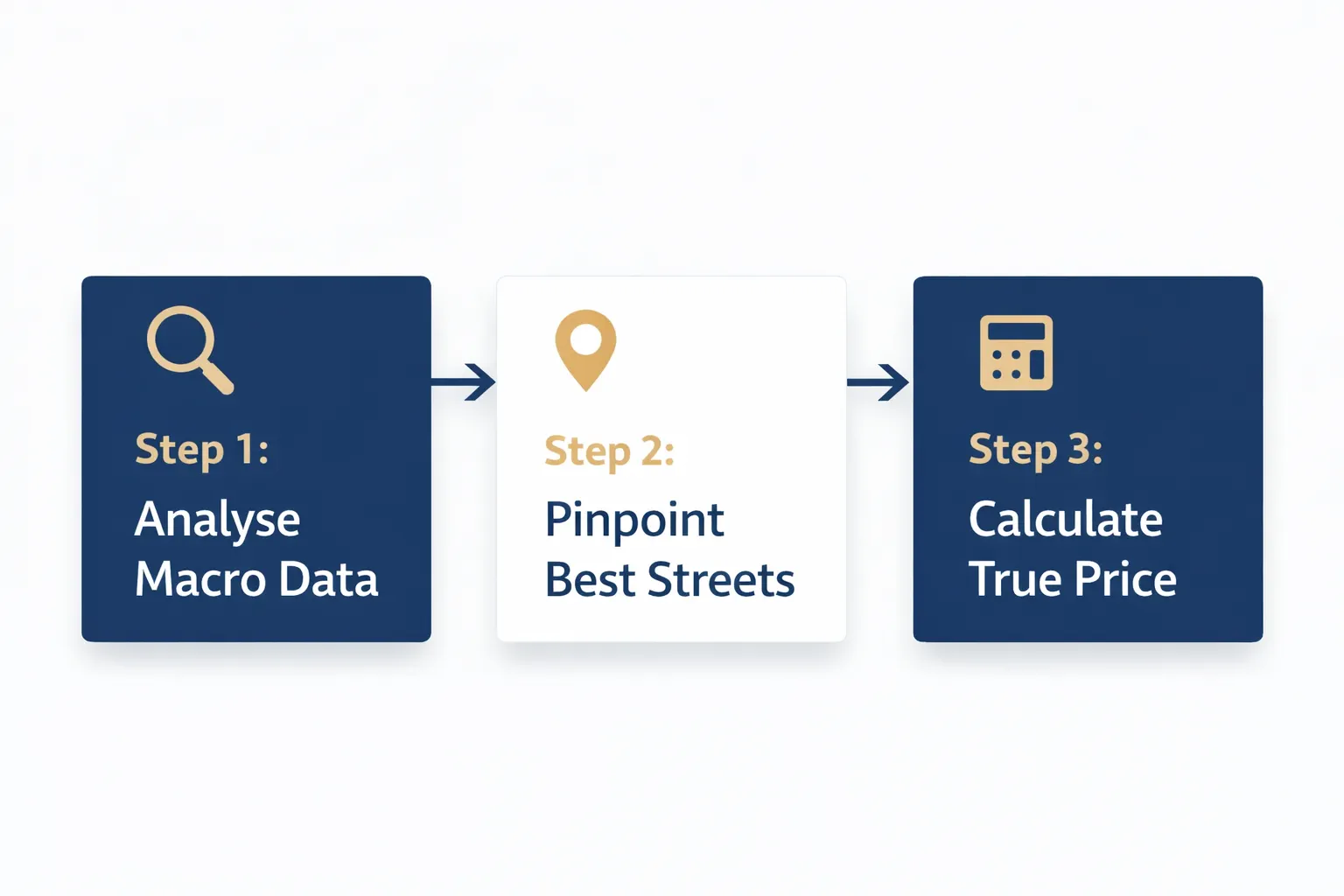
Key Takeaways On This 3-Step Framework for Growth
What are high-growth areas?
It's a suburb where objective data points to future demand. This includes significant government investment, positive population growth from high-income households, and consistently low rental vacancies.
Step 1: Analyse the Macro View
You'll identify suburbs with booming government projects, an influx of high-income professionals, and a shortage of rental housing. For instance, Greater Melbourne grew 2.7% in 2023-24 according to data from the Australian Bureau of Statistics.
Step 2: Pinpoint the Best Streets
Within a target high-growth suburb, you'll locate the walkable pockets near transport and amenities. You should also check local council zoning maps for hidden development potential.
Step 3: Calculate Its True Price
Use the Land-to-Asset ratio to ensure you're buying an appreciating property asset, not primarily a depreciating building.
Step 1: Analysing Key Indicators for Growth Suburbs
The first stage of the framework involves analysing high-level data to find suburbs with a solid foundation for growth.

Start by tracking significant government infrastructure spending. Official government websites, such as Victoria’s Big Build, publish their project pipelines. Following multi-billion dollar commitments in transport or healthcare is a reliable strategy. These projects create jobs and improve desirability, which underpins long-term property values in areas like the best investment suburbs north of the Yarra.
Next, you’ll want to analyse the market for tenants. A crucial metric is the Vacancy Rate, which measures the percentage of homes that are empty. A consistently low number signals that rental demand’s already outstripping supply. Identifying suburbs where vacancy has consistently been low confirms this pressure on the market. It’s one of the clearest key indicators of price growth.
Step 2: Finding the Best Property on the Best Streets
Once you identify a promising suburb, the next step is to find the A-grade pockets within it. It’s time to kick some goals and find the real gems. Not all streets are created equal. Recent market analysis reveals stark differences in performance, with Melbourne’s lower-quartile properties outperforming those in the upper quartile. This highlights the importance of street-level selection.
Open Google Maps and assess the walkability of a potential street. The best assets are typically located within an 800-metre, 10-minute walk of essential amenities such as a train station, a main cafe strip, and a park. This convenience creates a Walkability Premium, ensuring the asset’ll always be in high demand from both tenants and buyers.
You can also find hidden value by reviewing local council planning documents. Use online portals like VicPlan to search a council’s planning schemes or zoning maps. The goal is to find older homes on blocks currently zoned for a single dwelling but located in an area the council’s flagged for medium-density development. This allows investors to acquire the asset for its current use while gaining the potential for its more valuable use, often at no extra cost.

Need help applying this framework?
We can analyse market data and zoning maps to help you identify high-growth suburbs and develop a strategic plan.
Step 3: Calculating a Property's True Price & Future Value
This final step addresses the investor’s biggest anxiety: the fear of overpaying. We do this by calculating a property’s objective value, separate from the market hype.
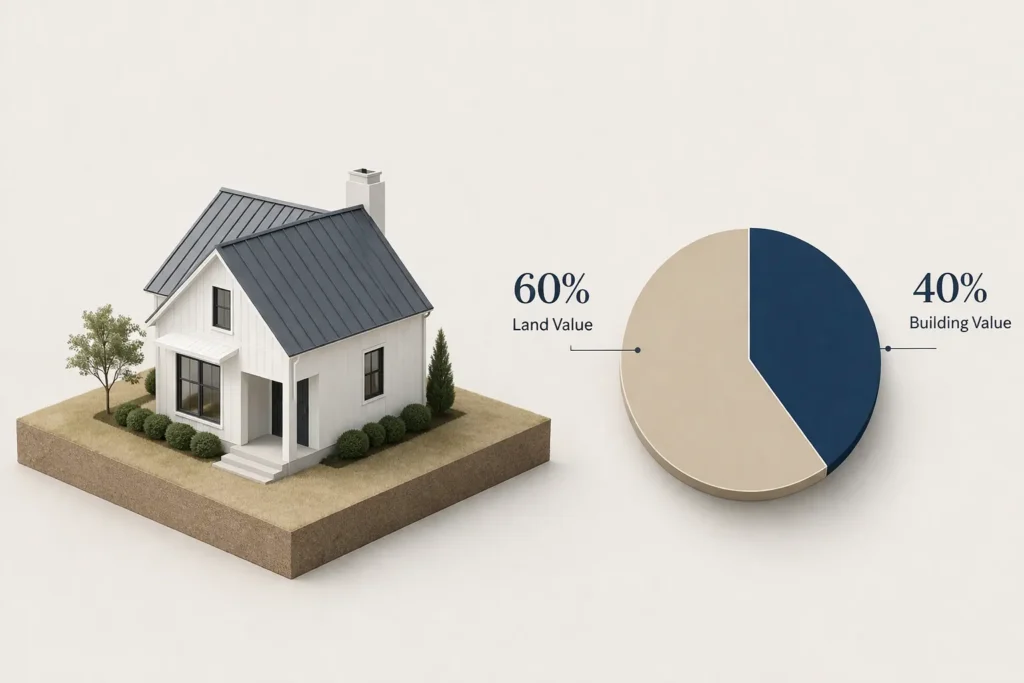
To do this, a valuer focuses on the Land-to-Asset Ratio. This is the percentage of a property’s total value that’s held in the land itself. A buyer’s advocate who’s also a Certified Valuer will perform this calculation to remove guesswork. A building depreciates over time, while the land beneath it appreciates. Targeting a ratio above 60% ensures that the majority of your capital is in the appreciating portion of the asset. This’s critical for strong capital growth.
This is fundamentally different from a real estate agent’s appraisal, which is a marketing figure. A formal valuation’s a legally recognised assessment based on hard facts, providing a precise price. It’s also vital to get a professional building and pest inspection. An asset that seems like a good purchase can hide significant structural issues. If a report finds defects, qualified tradespeople should quote the repair costs before an offer’s made. This allows you to factor the true cost into your purchase price.
Frequently Asked Questions
An appraisal's a marketing-focused price estimate, while a Certified Valuation's a formal, legally recognised assessment of the true market value of an investment property. The key tradeoffs are purpose and reliability. An appraisal's designed to be optimistic to help a real estate agent win a seller's business. In contrast, a Certified Valuation is conducted by an accredited professional using a strict methodology grounded in verifiable sales data. For a buyer or investor, the valuation provides an objective, backed price to prevent overpaying, whereas an appraisal reflects market sentiment.
To find a high-growth area before it becomes popular, an investor must analyse leading indicators of upcoming demand, not lagging indicators of past performance. This involves a three-stage analysis. First, track infrastructure investment. Monitoring major government commitments on sites like Victoria's project pipeline reveals where jobs and desirability will be created. Second, look at demographic shifts. Using figures from the Australian Bureau of Statistics to identify suburbs with rising household incomes and strong population growth signals growing purchasing power. Finally, assess supply and demand. Analysing suburb data to find growth suburbs with a vacancy consistently below 2% confirms that housing supply's already failing to meet current needs, which typically precedes price rises.
The Land-to-Asset ratio is critical because land is the component of a property that appreciates in value, while the building on it depreciates. For investors focused on capital growth, a higher ratio is better. For example, on a $1,000,000 asset, a 60% ratio means $600,000 of your capital is in the appreciating land. A low ratio, common with new apartments, means more money is tied up in the depreciating building, which can limit long-term returns. The tradeoffs are often between rental yield and appreciation, as new buildings may attract higher rent but grow in value more slowly. While national averages can fluctuate, recent property data shows that yields of 4–5% are achievable in certain Melbourne postcodes. Soaring above your financial targets means getting this balance right.
A great buyer’s agent combines market access with expert negotiation to secure the right property at the best price while saving you time and stress.
Ni Advocacy
Melbourne Buyers Agency
Ready to find your next high-growth asset?
A clear, data-driven strategy removes the guesswork and puts you in control. Let’s build your plan with complete confidence.