

Key Takeaways: The Professional Investor's Playbook
A professional portfolio is a system, not a collection of properties.
The goal is to create an engineered system of assets designed to generate predictable income and net returns.
The Core and Satellite model is the key for diversifying your property investments.
This structure uses stable, income producing assets (Core) to fund the acquisition of high growth holdings (Satellite).
Data, not emotion, dictates acquisition prices.
An evidence based property valuation, using recent comparable sales data, removes the risk of overpaying and protects future financial capacity and access to loans.
Proactive review and optimisation unlock hidden equity.
A property portfolio should be reviewed regularly to identify and redeploy trapped equity from low growth assets into new opportunities.
Pillar 1: Your Property Portfolio Strategy for Growth
A professional property portfolio is engineered before a single asset is purchased. There are many plans to create an investment portfolio, but one of the most effective for expansion is the Core and Satellite structure. It’s designed specifically to solve the common investor problem of being asset rich but cash poor: a situation where valuable holdings don’t generate enough positive income to fund further acquisitions.
This is a common challenge, as ATO data shows that approximately 71% of Australian investors own just one property, exposing them to concentration risk. This approach is fundamental to successfully managing finances for multiple rental properties.
This structure focuses on diversifying property investments to blend stability with targeted expansion. As outlined by ASIC’s MoneySmart, diversification is crucial for lowering risk by balancing different assets. A 2024 CoreLogic report confirmed this approach works, showing that diversified holdings consistently outperform concentrated ones. A diverse property collection’s key.
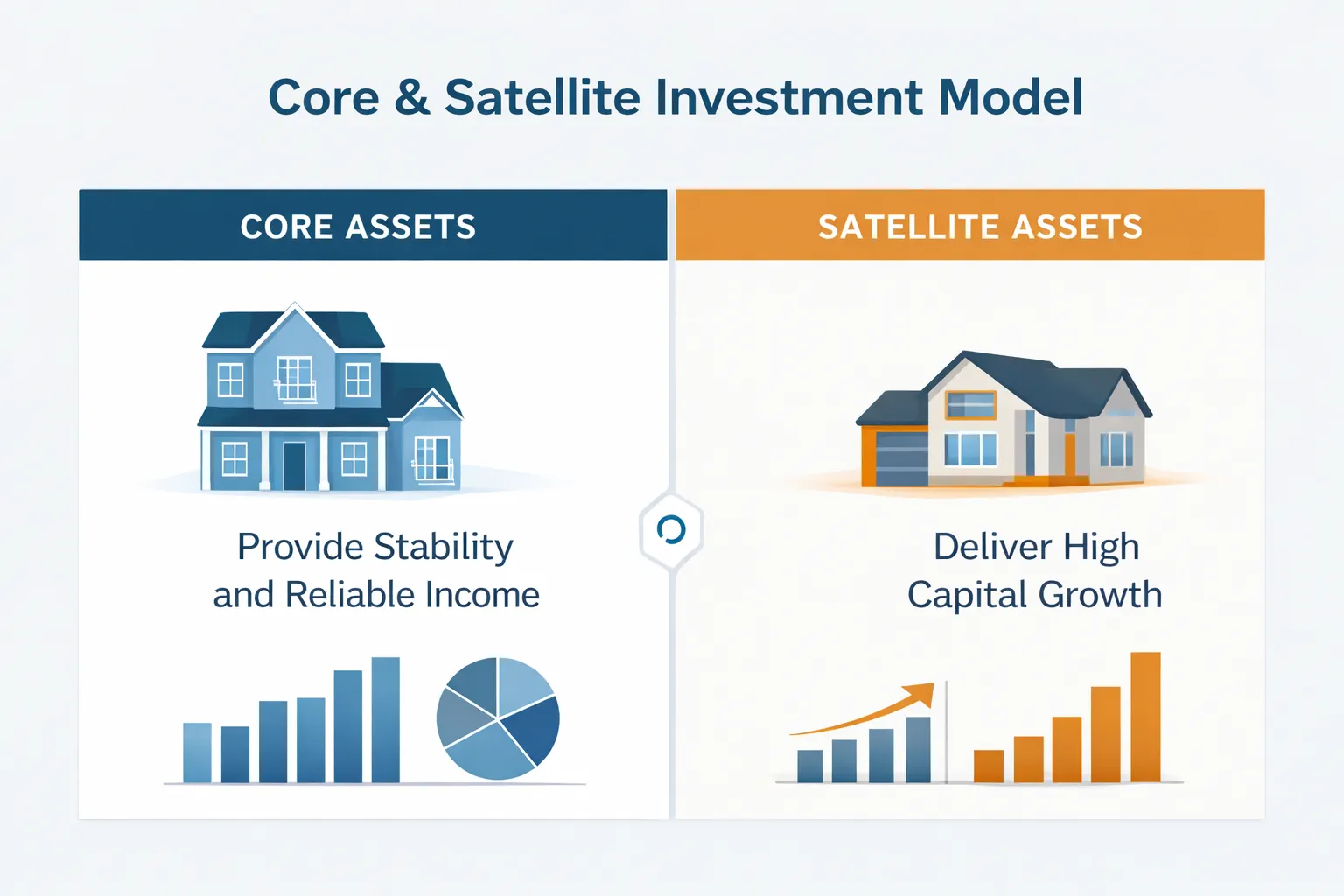
The Mechanics of Diversifying Property Investments
Asset Type
Core Assets
The Role of This Asset in Your Portfolio
Provide Stability and Reliable Income
Example
A townhouse in a blue chip suburb like Glen Iris.
Asset Type
Satellite Assets
The Role of This Asset in Your Portfolio
Deliver High Capital Growth
Example
A house in a new growth area like Melton.
The Core holdings are the engine room. They generate predictable income and stable equity, which is then used to finance the purchase of higher risk, higher reward Satellite assets. The framework’s designed to balance risk.
Our team, for instance, models a 70/30 split between Core and Satellite assets to ensure a stable income stream can fund future opportunities. This creates a self sustaining and scalable financial system.
Ready to Scale Your Wealth with a High Performance Portfolio?
Partner with Ni Advocacy for expert led portfolio development, data driven acquisition strategies, and the professional support you’ll need to secure long term financial growth.
Pillar 2: Acquiring the Right Investment Property
Professional investors never acquire assets based on guesswork. The acquisition process is driven by a forensic, data led valuation to eliminate the risk of overpaying, which is a stark contrast to the average buyer’s journey that can take 6-9 months from preparation to settlement. This avoids The Winner’s Curse, an auction scenario where the winning bidder is often the one who has most inaccurately valued the asset. We’ll provide the support needed to avoid this.
A professional valuation follows the strict standards of the Australian Property Institute (API). It’s not an opinion. It’s an evidence based calculation derived from a direct comparison of recently sold homes, using objective metrics:
- Land Size: Measured in square metres.
- Building Area: Internal living space.
- Condition and Age: Recently renovated vs original condition.
- Location: Same street or a directly comparable one.

The Impact of a Single Valuation Error
Overpaying for one asset doesn’t just lose money, it damages financial momentum. An incorrect valuation leads to two significant problems:
- Reduced Borrowing Power: If you overpay, a bank’s independent valuation will likely come in lower, impacting credit and the ability to secure future loans. This forces a larger cash contribution to the deposit, tying up funds that were allocated for the next purchase.
- Delayed Equity Development: An overpayment of $50,000 on a home can take years of market appreciation just to break even, delaying the point at which its equity can be used to reinvest.
This discipline ensures that capital is protected, making it easier to qualify for subsequent investment loans. This isn’t about being stubborn. It’s about being smart and ensuring a financial plan soars above targets from day one. A data driven valuation is a risk management tool that protects the ability to scale investments, much like good landlord insurance.
Unsure where trapped equity's hiding in investments?
A professional audit provides a clear roadmap for the next high appreciation purchase.
Pillar 3: Management, Time and Maximising Rental Yield
A property portfolio’s not a set and forget investment. Professional fund managers constantly conduct reviews and optimisation to maximise performance, which includes everything from asset acquisition to understanding how property manager choice affects investment returns. This involves two key activities: accessing superior opportunities and proactively redeploying property funds.
The best investment grade assets are frequently sold off market: privately, without public advertising. This market’s significant, with some reports estimating that as many as 1 in 5 Australian properties sell off market. These opportunities aren’t found on major real estate websites. They’re sourced through deep industry networks. These tips’ll save valuable time.

Deciding When to Sell an Investment Property
The second part of active management is knowing when to act. Deciding when to sell’s a critical component of optimisation. When a Core property has experienced a strong appreciation cycle and its rate of value increase begins to slow, it needs to be reviewed.

The goal is to calculate the Opportunity Cost of leaving funds tied up in a low performing asset, considering factors like tax implications and insurance premiums. Understanding the nuances of deductible expenses and capital gains is crucial, and the ATO Rental Properties Guide is an essential resource. For example:
- Equity trapped in a slow appreciation asset: $200,000
- Current annual rate of that asset: 4%
- Potential of a new Satellite property: 8% per year
That 4% difference represents $8,000 per year in potential returns that’s being lost. A professional investor actively unlocks this trapped equity and redeploys it into assets with higher potential. This is how you’ll start kicking real financial goals, actively engineering wealth instead of passively waiting for it.
A Recap of Your Professional Investor Playbook
Executing a high performance plan comes down to discipline. Here’s the summary of the fund manager’s framework for a financial future with property:
- Strategise First: Structure your holdings with the Core and Satellite model to balance risk and reward.
- Acquire with Data: Anchor every purchase in an evidence based valuation to protect funds and borrowing power.
- Manage Proactively: Constantly review assets to unlock trapped equity and leverage industry networks to access off market deals.
Frequently Asked Questions

The Core and Satellite investment strategy is a framework for diversifying holdings to balance risk and appreciation. Core assets are stable, blue chip properties that provide a reliable income and a solid rental yield. Satellite assets are properties in high appreciation areas that offer higher potential for an increase in value but may come with more risk. The income from the Core is used to safely fund the acquisition of the Satellite properties.
A property portfolio should be reviewed at least annually. The purpose of a review is to assess the performance of each asset, identify underperforming holdings, and calculate trapped equity that could be redeployed into new, higher appreciation opportunities. This proactive management is crucial for maximising long term returns.
Neither's better. A successful investor needs both. Positive cash returns from rental income provide financial stability and the funds to acquire new properties. An increase in property value builds net worth. The Core and Satellite model explicitly balances this: Core assets are chosen for a strong income stream, while Satellite assets are chosen for high potential appreciation.
Avoiding overpayment is critical because it directly impacts the ability to scale. Overpaying for one investment property ties up funds in a single asset, reduces borrowing power for future purchases, and delays the time it takes for that holding to become profitable. A data driven valuation ensures you'll buy correctly, protecting the momentum needed for long term expansion.
Ni Advocacy
Melbourne Buyers Agency
Prefer to have an expert execute this plan for you?
A specialist uses a data driven approach to acquire properties engineered for long term wealth.