

Key Takeaways On Your 20-Year Investment Blueprint
The Core Prediction
The long-range outlook for Melbourne property is strong, with steady growth driven by a structural dwelling shortage and major infrastructure projects.
The Mechanics of Valuation
To avoid overpaying, you must disregard misleading median figures and instead use a valuer's comparative analysis method to calculate a specific property's true market worth and the correct property values.
The Core Investment Strategy
The best returns come from acquiring scarce assets that cannot be easily replicated, specifically, a dwelling with a high land-to-asset ratio or a unique "unicorn" apartment.
The Justification for Confidence in Long-Term Growth
A long-term prediction’s only useful if it’s built on a solid foundation. In Melbourne, two key factors create a permanent steel floor under property values, giving you the confidence to invest through any cycle and confirming it remains an investor hotspot.


Pillar
1. Relentless Population Growth
The Data-Backed Reality
Melbourne’s population is projected to exceed 7 million between 2032 and 2046, while wider Victoria’s forecast to reach 10.3 million residents by 2051. This isn’t a guess; it’s a structural shortage of dwellings that creates permanent, built-in demand.
The Impact on Your Asset
This is a simple supply-and-demand equation. Constant demand from an increasing number of residents, combined with a very low vacancy rate, provides durable support for sustained price growth.
Pillar
2. Massive Infrastructure Investment
The Data-Backed Reality
Huge government projects like the Suburban Rail Loop, with construction starting in 2022 for a 2035 operational date, fundamentally rewire a suburb’s desirability. This spending is publicly tracked on the Big Build website.
The Impact on Your Asset
In my experience, watching where the government spends billions of dollars is the most reliable indicator of where private capital and future capital appreciation will follow. In fact, official analysis shows such infrastructure can add a 4-7% value uplift for nearby properties.
Now that you understand the “why” behind the prediction, the roadmap shifts to the “how”, which are the specific mechanics you must use to profit from this expansion.
The Mechanics of Correct Property Valuation to Avoid Overpaying
A 20-year strategy can be destroyed on day one by paying too much. The most common mistake investors make is relying on a suburb’s “median value”, which is an often misleading metric that isn’t a useful tool for making a precise financial decision.

The Flaw in Median Data
A median figure lumps all property types together, including fully renovated homes, knockdown jobs, and apartments. Because it’s a blunt average, it cannot tell you the true value of the specific property you want to buy. A detailed analysis of Melbourne property market statistics is required to understand an asset’s precise value.
The correct way to determine a property’s value is to use the same mechanical process as a Certified Practising Valuer. It involves two steps:
- Find 3-5 properties that’ve recently sold and are almost identical to your target asset.
- Make specific dollar-value adjustments for any differences between them.
For example, if a comparable dwelling sold for $1.5m, you’d adjust its sale figure based on evidence:
- It had a superior kitchen: You’d subtract $20,000 from its sale figure.
- Its block of land was smaller: You’d add $35,000 to its sale price.
This process produces a hard, data backed number, not an emotional guess. It’s this analytical approach that forms our Valuer’s Edge, ensuring clients negotiate with data, not hype. This figure becomes your non-negotiable limit, protecting you from the fear and agent-driven pressure that causes many to overpay. It’s a critical step for any savvy buyer.
The Core Strategy Is How to Outperform the Market by Acquiring Scarce Assets
Once you know how to value an asset correctly, the next step is to apply that skill to the right kind of property. The single most important rule for outperforming the sector over the next two decades is to acquire assets that are scarce, meaning things that cannot be easily copied.

Focus on these two types of scarce properties:
- Dwellings where the land’s the hero: The simple test is to ask if the building burned down, would the empty land itself still be extremely valuable? If the answer’s yes, it means most of the property’s value is in the land itself. Historically, research shows these land-rich sites in inner suburbs have outperformed outer areas by 10-15% over decades.
- “Unicorn” apartments: These are apartments with unique features that protect them from competition, such as being in a small Art Deco block of only six residences, having a large private courtyard, or a floor plan that feels more like a small home.
The principle is to always buy the property that’s hardest to replicate. This is your best defence against the thousands of generic, cookie-cutter developments that can dilute and suppress value appreciation.
Struggling to find scarce assets in a competitive landscape? A clear mandate is the first step to focusing your search on properties that outperform.
— Kevin Ni, Managing Director

Need Help Finding Scarce Assets?
Our expertise lies in identifying unique properties with high growth potential before they hit the public market.
The Complete 4 Step Acquisition Roadmap
This is the system that turns a long-term prediction into a real, wealth-building asset. Following a disciplined process is what separates a focused, successful acquisition from a stressful, six-month search.
Step 1: Audit Your Financial Position
Before looking at any real estate, model the asset’s future holding costs in a spreadsheet. You must include every expense, including council rates, water, insurance, land tax, and a maintenance budget. A good rule’s 1% of the property’s value annually. This ensures the purchase is financially sustainable and you’ve got your finances in order.

Step 2: Define Your Buying Mandate
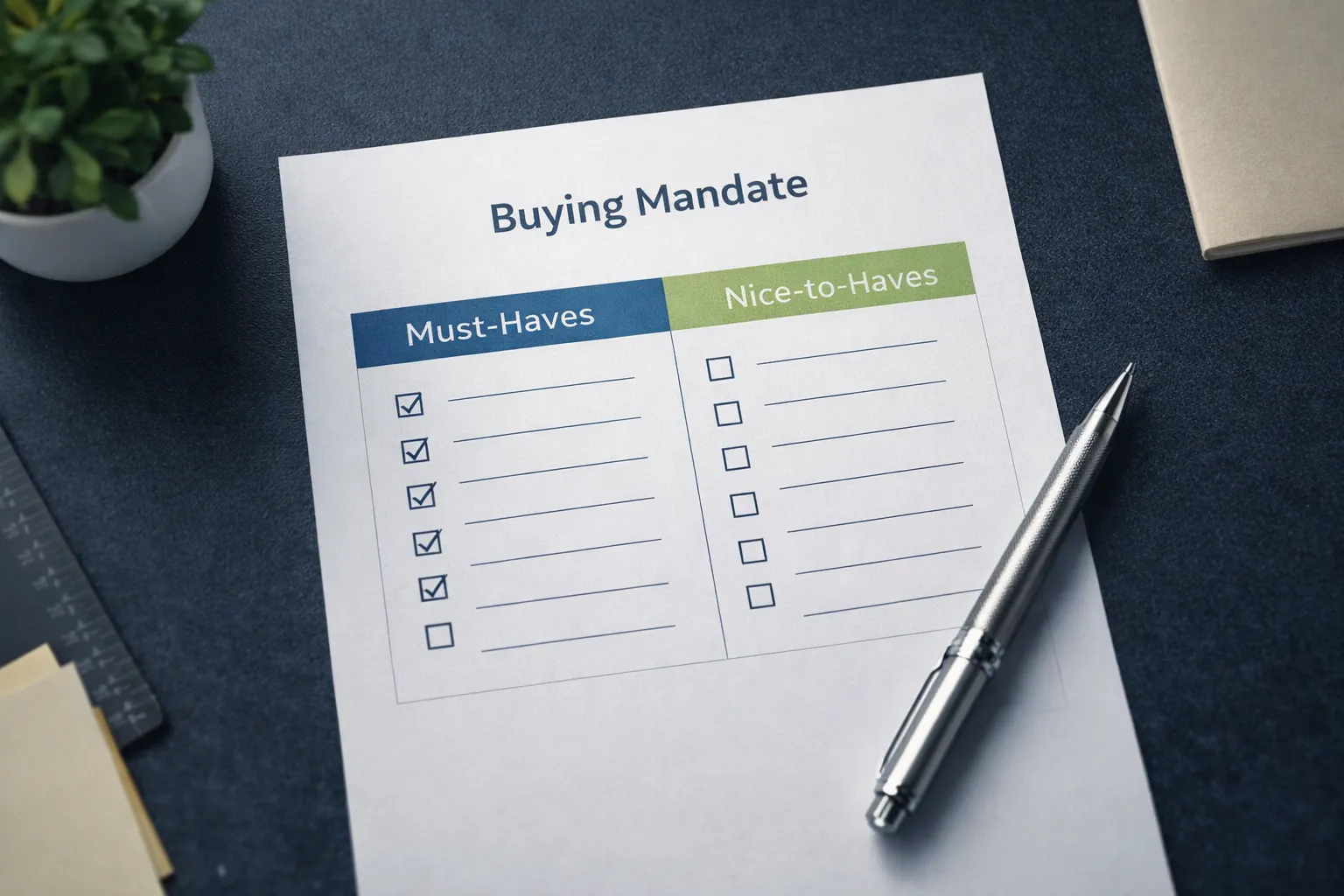
Create a clear, one-page document with two columns for “Must-Haves” and “Nice-to-Haves”. Be specific about non-negotiable criteria like location boundaries, minimum land size, and property condition. This document’s your compass. It prevents emotional compromises and keeps the search focused.
Step 3: Access and Vet Off-Market Properties
An advantage comes from seeing real estate that the public never does. This is achieved by building relationships with the top real estate agents in your target area. A key part of our system involves leveraging these professional networks daily to present clients with opportunities before they’re publicly listed. Once a property’s sourced, the vetting process involves a meticulous review of the legal documentation and the coordination of independent building and pest inspections to ensure it’s a safe acquisition.

Step 4: Value and Negotiate with Data
Use the valuation method described earlier to set your absolute maximum figure before you make an offer. This allows you to negotiate from a position of power, using logic and data. Our private negotiation service specialises in this final, critical step in the acquisition process.

Property Prices FAQ and Market Outlook
The 20-year outlook for the Melbourne property market predicts sustained and consistent value appreciation. This positive projection isn't based on immediate trends but on two fundamental, long-term drivers. These include population growth creating a structural housing shortage, and massive government investment in infrastructure such as the Suburban Rail Loop, which will increase the value and desirability of entire corridors across Australia. For further reading, see our broader Melbourne market analysis and forecasts.
For those seeking maximum capital appreciation in Melbourne, a dwelling with a high land-to-asset ratio is typically the superior asset. The reason is the scarcity of land, which is a finite resource. In contrast, apartments can be built upwards, making them less scarce. However, a "unicorn" apartment, which has unique features such as being in a small Art Deco block or having a large private courtyard, can also be an excellent long-term asset, as its scarcity protects it from competition.
Predicting the best Melbourne suburbs for long-term appreciation involves analysing where government infrastructure spending is planned. Large-scale projects, such as new train lines or hospital upgrades, are reliable indicators of future private investment and demographic expansion. For more specific insights, you can review our analysis of Melbourne's top suburbs for growth. Tracking the state's Big Build portal provides verifiable data on these future growth corridors.
Yes, historical value appreciation is a useful indicator when analysed correctly. Looking at long-term data for Melbourne real estate reveals that assets with inherent scarcity, such as land-rich houses, have consistently outperformed more generic, high-supply assets like standard apartments. For instance, long-term data shows Melbourne houses have historically outperformed units in annual growth. While past performance doesn't guarantee future results, it validates the core principle that scarcity is a powerful driver of long-term price growth in the property market.
Ni Advocacy
Melbourne Buyers Agency
Ready to Execute Your 20-Year Plan?
Understand the strategy, but need an expert to manage the acquisition? Let us handle the entire process for you.