

Key Takeaways:
What is a Property Auction Blueprint?
It's a three-step system focused on data, not emotion. It involves establishing a hard ceiling, executing disciplined bidding strategies, and using data to negotiate effectively if the property passes in.
Step 1: Fortify Your Position Before the Bidding Starts:
You must conduct all due diligence, understand the rules and regulations, and establish a non-negotiable "Market Ceiling" based on a certified valuation before the day.
Step 2: Execute Your Bidding Strategy:
During the event, control the tempo by staying silent at the start and using unconventional bid increments to disrupt other buyers' emotional rhythm.
Step 3: Master the Passed-In Negotiation:
If the property doesn't sell, learn how to negotiate a private property sale from a position of strength, offering the seller a certain and immediate outcome.
Step 1: Pre-Bidding Strategy to Fortify Your Position
Securing a property at auction happens in the week before, not on the day. Amateurs walk in with a hopeful budget. Professionals walk in with a fortified position built on two pillars: complete due diligence and hard data limits. This preparation is key to any successful outcome at auctions.
Pillar 1: Complete All Due Diligence and Understand the Rules
You must uncover any potential issues before you’re legally committed. A critical part of this is understanding official auction rules and regulations in Victoria. A buyer’s agent coordinates independent building and pest inspections and ensures you complete the mandatory due diligence checklist to ensure the property is physically sound.
Our team, for example, operates on a strict ‘no major defect’ mandate, meticulously reviewing the Section 32 alongside these checks to ensure clients only ever see safe investments. This includes a full legal review of the Contract of Sale to identify any red flags, such as restrictive covenants or unusual settlement terms. While making a pre-auction offer is a possible strategy, you must complete this diligence first.

Pillar 2: Establish Your Market Ceiling
Your “Market Ceiling” is your non-negotiable walk-away figure. It’s not a guess. It’s a hard limit calculated through a formal valuation process that assesses recent comparable sales from sources such as Valuer-General Victoria, land-to-asset ratios, and the property’s unique features. This is the foundation of the valuer’s edge and how to succeed at a property auction without overpaying.

Why this matters: This figure’s your defence against the greatest risk at any auction: the “Winner’s Curse.” This is the proven theory that the successful buyer often overpays. Recent studies on the winner’s curse show that bidding wars can result in 5-10% lower subsequent performance for winning transactions. In Victoria, factors like underquoting amplify this risk by attracting more emotional bidders.
Setting a Market Ceiling ensures that walking away isn’t losing. It’s a financial victory that protects you from a catastrophic mistake.
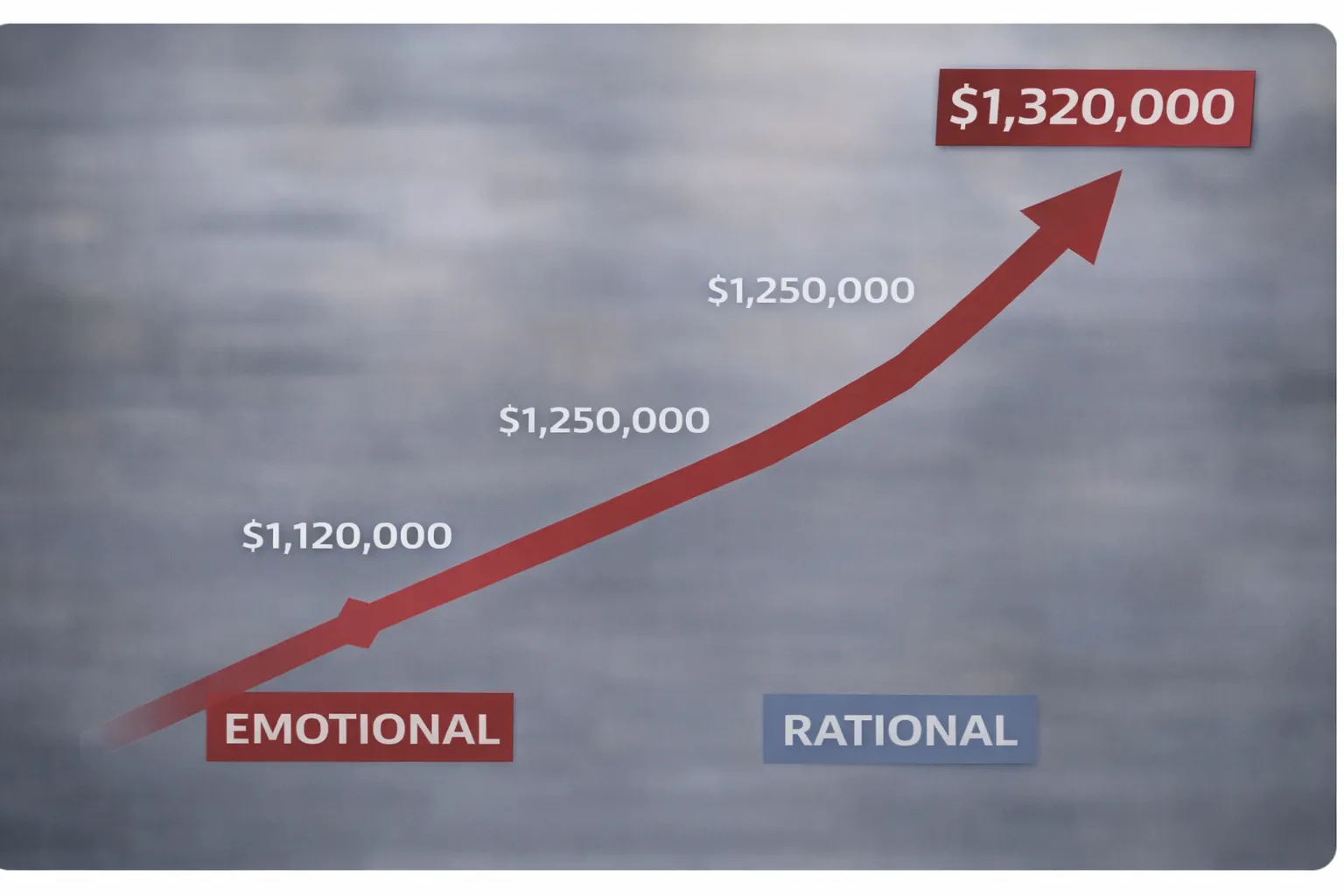
Step 2: Bidding Strategies to Control the Room
The auction room’s designed to fuel emotion. Your blueprint’s designed to execute calm, logical, and effective bidding strategies. Understanding the process, including what a vendor bid is, is crucial for developing a winning auction strategy. While this guide covers traditional methods, it’s also worth looking into new bidding strategies to gain every possible advantage.

The "Quiet Start" Bidding Method
- Don’t be the first to bid. Opening the bidding only helps the auctioneer build momentum for the seller. Let another buyer do that work for them.
- Wait for the auction to pause. Most auctions have an initial flurry of activity from multiple bidders and then slow down. This moment of silence is your signal to enter with confidence.
- Use odd bid increments. The selling agent wants neat, predictable jumps of $10,000. A smaller, unconventional bid of $2,000 or $3,500 disrupts this rhythm. It forces the auctioneer to reset and can shatter the confidence of emotional bidders. It’s about playing chess while they’re playing checkers.
- Know how to handle a vendor bid. A vendor bid is a bid made by the auctioneer on behalf of the seller. It’s used to keep the auction moving, but must be announced. Don’t be intimidated by it. Treat it as just another bid and stick to your strategy.
Step 3: How to Negotiate a Private Property Sale When it Passes In
If bidding doesn’t reach the seller’s reserve amount, the property is “passed in.” At this moment, the power dynamic flips entirely in your favour. The vendor’s now under immense pressure, and you have the exclusive right to negotiate first. This is where engaging a skilled private negotiation expert becomes your most valuable asset.
The Post-Bidding Pivot for a Private Sale
Don’t rush the agent. Wait 10 minutes. Rushing in signals desperation. Waiting signals calm, calculated control.
Anchor the negotiation in data. Don’t discuss feelings or opinions. Present a clean, one-page summary of your valuation data. This grounds the conversation in market reality.
Leverage certainty as your weapon. State your position clearly: “We’ve unconditional finance, the deposit’s ready, and we can sign the contract at [Your Figure] in the next 30 minutes.”
For a seller who’s just faced the public stress of a failed auction, a guaranteed sale today is often more valuable than the hope of a higher amount in the future. This data-led approach removes emotion and grounds the conversation.
It’s a core part of the system we use to secure properties under pressure for our clients. Suddenly, you’re not just a buyer. You’re their fast-track ticket out of a stressful situation. That’s how we start kicking goals.
What Happens After Your Successful Bid
Once the hammer falls and you’re the successful buyer, your preparation pays off. A key legal point to remember is that auction contracts in Victoria are unconditional, meaning they come with no cooling-off period. You’ll immediately be required to:
- Sign the Contract of Sale.
- Pay the 10% Deposit. This is typically done via a bank transfer on the spot.
From there, your legal representative’ll guide you through the settlement period, which culminates in a final inspection of the house before you officially take ownership. By following this blueprint, you’ll navigate the entire process with clarity and the confidence that you’ve made a brilliant financial decision for your new property.

FAQs on Property Bidding & Negotiation
A vendor bid is a bid made by the auctioneer on behalf of the seller. It's a legal and common practice in Australian auctions, used to start the bidding or to keep momentum going if bidding stalls below the reserve price.
You should react to a vendor bid as you would any other bid: stay calm, acknowledge it, and stick to your pre-determined bidding strategy and ceiling. It doesn't change the property's true market value.
Making a pre-auction offer will be a good strategy if your primary goal is to avoid the stress and competition of the day. However, it involves clear tradeoffs.
- Pros: You might secure the property for a fair amount without public competition and you'll often include conditions in your offer, such as a finance clause.
- Cons: You risk revealing your highest offer to the agent, who'll use it to set a higher reserve. A strong offer will also motivate the vendor to bring the auction forward, increasing pressure.
If a property passes in, the highest bidder typically earns the exclusive right to negotiate with the seller. The most effective negotiation strategies are to immediately anchor the conversation in data, not emotion. You'll present your valuation and comparable sales analysis to the agent to justify your offer.
Emphasise your certainty as a buyer: that you've unconditional finance and're ready to sign the contract immediately. This offers the vendor a swift resolution, which is highly valuable after a failed auction.
The single biggest and most costly mistake is emotional bidding. This happens when a buyer gets caught up in the excitement and bids beyond their pre-determined, data-backed financial limit.
This leads directly to overpaying, a phenomenon known as the "Winner's Curse." The most effective way to prevent this is to establish a firm "Market Ceiling" based on a professional valuation before the auction and commit to never exceeding it, no matter what happens on the day.